
Alamance Court Records After Arrest
After an Alamance County arrest, the first public record may be a booking row in the jail roster. That row is a custody record. It can show the person's name, primary charge, arrest date, and booking agency. The court record is separate. It begins or continues in the North Carolina court system and reflects the case number, charging document, hearing dates, charge status, bond conditions, and final outcome. A person may be in jail while the court case is pending, or the person may be released while the court records continue to update.
Formal prosecution in Alamance County runs through Prosecutorial District 17. The North Carolina Conference of District Attorneys identifies Sean Boone as the district attorney for Alamance County, and the Judicial Branch county directory lists District Attorney phone 336-570-5210. The prosecutor may proceed on the arrest charge, file a different charge, dismiss a charge, reduce it, or seek an indictment. For custody and booking details, use Alamance County jail inmate records. For booking photos, use the Alamance County jail mugshots page.
Find Court Records After Arrest
The North Carolina eCourts Portal is the online starting point for case information where Alamance records are available. The Judicial Branch's Alamance County page also links court date search, calendars, and local services. Public terminals and paper files remain important because the Judicial Branch tells people performing background checks to use the county clerk's office rather than relying only on Portal. The Clerk of Superior Court main number is 336-570-5200.
- Open the North Carolina eCourts Portal or the Judicial Branch Alamance County page.
- Search by defendant name, citation number, case number, or county when those fields are available.
- Open the case record and compare the charge list with the jail roster's primary charge.
- Check hearing dates through the North Carolina court calendars if a date is not clear.
- Use the clerk's office for paper files, public-terminal searches, copies, and background-check needs.
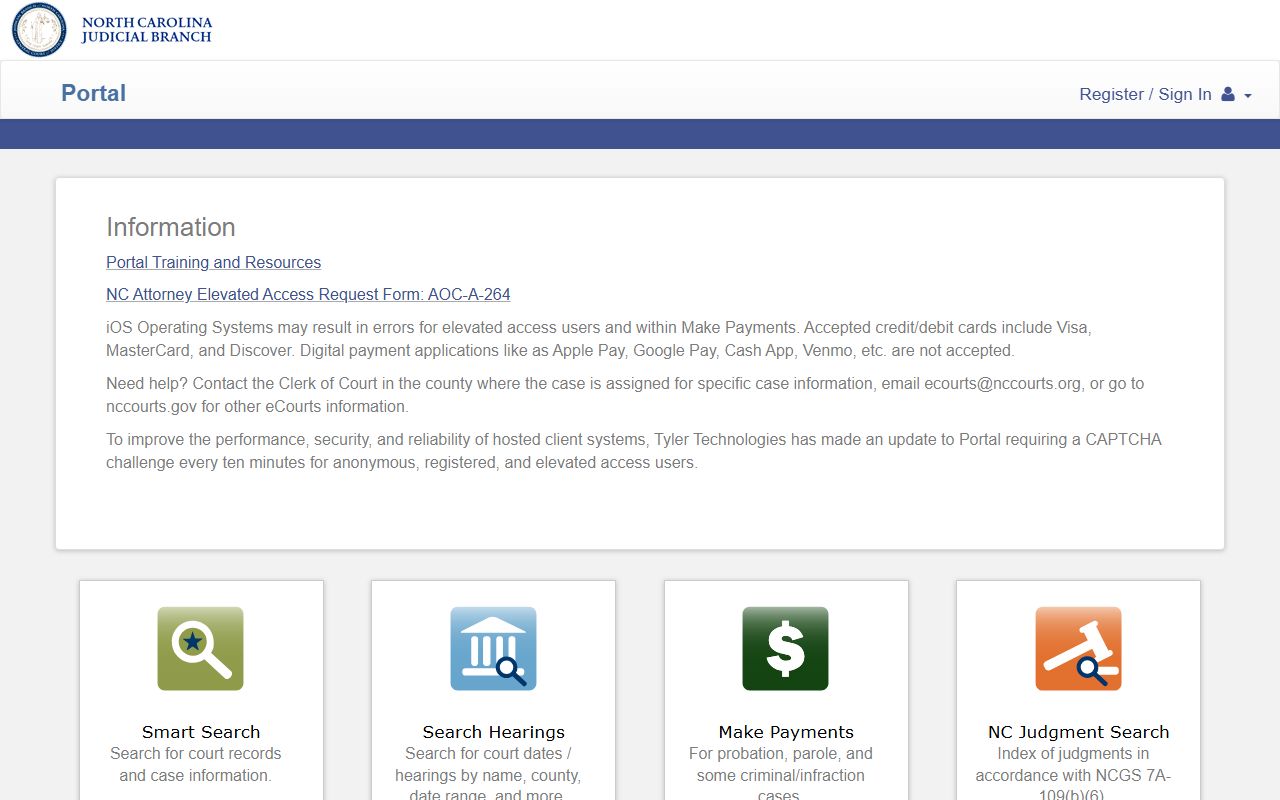
The state Portal image at North Carolina eCourts Portal shows the case-search entry point used for Alamance County court records after an arrest.
Online search is helpful, but the clerk remains the official route for older paper files, certified copies, and background-check record searches.
Alamance Court Search Fields
Research found several access fields for court records after a jail arrest. Some are in Portal, some are in court calendar tools, and some are used at clerk public terminals. Search by the broadest reliable fact first, then narrow by Alamance County, case number, citation number, or date. A jail booking charge is useful context, but it is not a court case number.
| Field | Type | Use |
|---|---|---|
| Defendant Name | Text | Name search for criminal case records and public terminal lookup. |
| Citation Number | Text | Useful when the arrest or charge began from a citation. |
| County | Filter | Select Alamance County to narrow statewide results. |
| Case Number | Text | Best when a court file number is already known. |
| Attorney | Text | Portal materials describe attorney search in eCourts counties. |
| Court Date | Date/calendar | Use calendars to confirm upcoming criminal settings. |
Charges Filed After Arrest
The path is arrest, booking, initial judicial review, prosecutor review, then a court case record. The exact charging document depends on the charge, court level, and case posture. The research did not find a county-only charging form page, so the safest description is the North Carolina criminal-court process in local context. A complaint, information, or indictment can be the document that gives the court its formal charge record.
| Document | Who Uses It | Plain Meaning |
|---|---|---|
| Complaint | Law enforcement or prosecutor | Starts or supports a criminal accusation after an arrest. |
| Information | Prosecutor | Formal charging document filed by the state in eligible cases. |
| Indictment | Grand jury | Formal accusation used in superior court for serious felony prosecution. |
Alamance Charge Status
Charge status can change after a jail arrest. The jail roster's primary charge may be the first label attached to the booking. The court record can later show a different result because the district attorney may dismiss, amend, reduce, supersede, or indict charges. Read each count separately. One charge can be dismissed while another remains pending, and a bond change does not mean the case is over.
| Status | What It Means |
|---|---|
| Pending | The charge or case has not reached a final court outcome. |
| Dismissed | The charge ended without a conviction on that count. |
| Amended or reduced | The charge changed from the original version. |
| Superseding indictment | A later indictment replaces an earlier charging document. |
| Disposition | The final outcome entered for a charge. |
| Conviction | A formal finding or admission of guilt, not the same as an arrest. |
Bond After an Alamance Arrest
North Carolina pretrial release is governed by G.S. 15A-533 and G.S. 15A-534. The P2C grid inspected for Alamance did not show bond in the visible roster or public handler rows. For current bond status, use the detention center, magistrates, clerk, or court record. Magistrates are listed at 336-570-5219, and the clerk main number is 336-570-5200.
| Release Type | How It Works | Alamance Note |
|---|---|---|
| Written promise | Nonfinancial promise to appear and obey conditions. | Depends on charge facts and statute. |
| Unsecured bond | Money may become due after failure to appear. | Confirm current eligibility with court officials. |
| Secured bond | Money, property, or surety backs release. | The public P2C grid did not confirm amounts. |
| Surety bond | A licensed bail agent may post surety. | Use only licensed North Carolina agents. |
| No-bond or hold | Release is blocked or paused. | May involve probation, parole, ICE, another county, or court order. |
Warrants and Court Records
No dedicated Alamance sheriff active-warrant search was located in the official sheriff resources. The sheriff's public-records page gives the key routing instruction: requests for arrest and search warrants should go to the Alamance County Clerk's Office or the North Carolina Administrative Office of the Courts, not to the sheriff records process. If a warrant has resulted in a booking, the jail may confirm current custody at 336-570-6317, but the warrant and court file are court-controlled records.
Warrant-linked court records may show the defendant name, case number, charge, issuing court, issue date, bond or release condition, service information, and the next court date. Do not assume every field appears online. For a court date after warrant service, use the court calendars or contact the Judge J.B. Allen Jr. Criminal Courthouse at 336-570-5202.
Charges, Convictions, Sealing
Court records after an arrest must be read with care. A charge is an accusation. A conviction is a final legal outcome after a plea, verdict, or other court action. Sealing and expunction are also different. North Carolina expunction law, including G.S. 15A-145.5, is eligibility-based and should be checked with the clerk or a lawyer.
| Issue | First Term | Second Term |
|---|---|---|
| Charge vs. conviction | Charge: an accusation filed in court. | Conviction: a final finding or admission of guilt. |
| Dismissal vs. acquittal | Dismissal: prosecution of a charge ends. | Acquittal: not-guilty result after trial. |
| Sealed vs. expunged | Sealed: hidden from public access in limited contexts. | Expunged: removed by court order when legally eligible. |
Important: Do not use jail or court lookup results for employment, housing, credit, insurance, or other FCRA-covered screening.
Restricted Alamance Court Records
North Carolina's Public Records Act starts from public access, but criminal investigations and criminal intelligence records have special rules under G.S. 132-1.4. Juvenile records, sealed files, expunged records, confidential victim information, medical information, and active investigative material may be restricted. A booking record, public court index, and full investigative file are not the same thing.
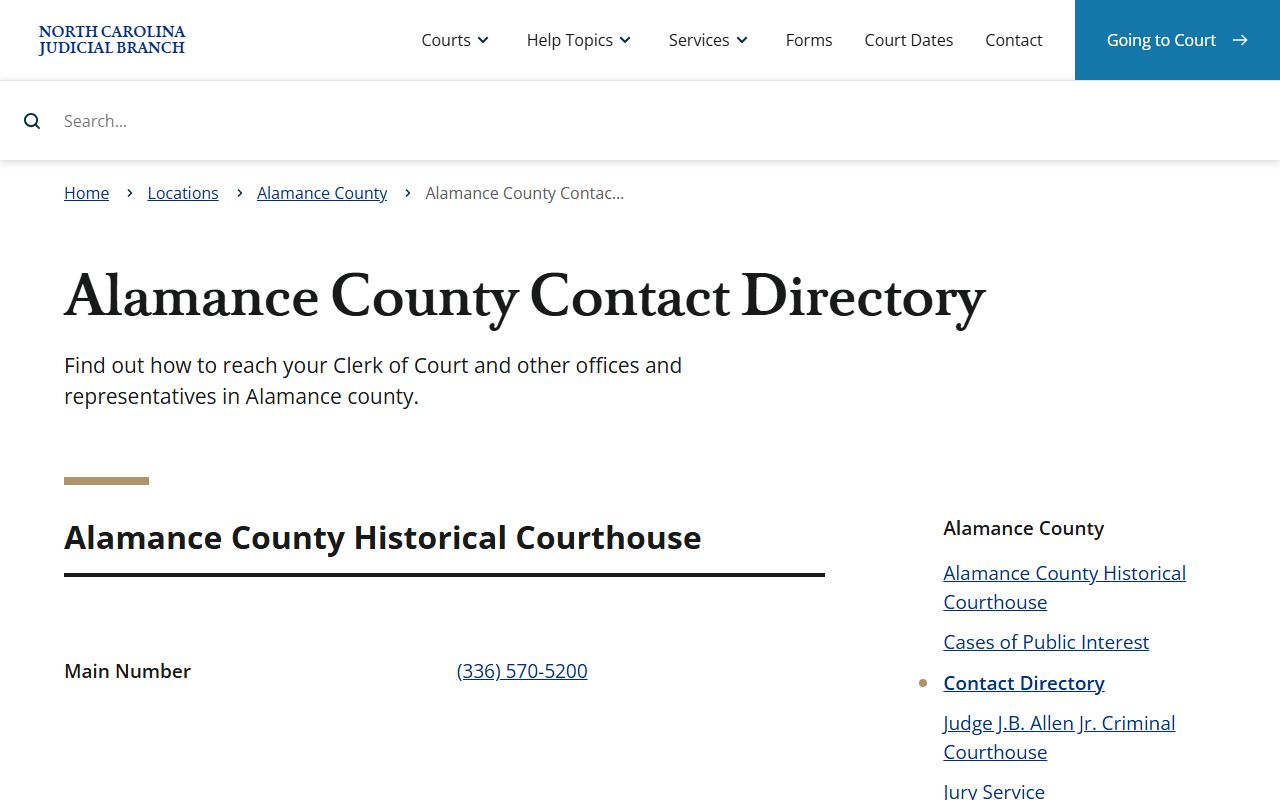
The Judicial Branch's Alamance contact directory is a practical routing tool. It separates the clerk, district attorney, magistrates, public defender, court coordinators, and courthouse numbers. The screenshot from the Alamance County court contact directory shows those local court contacts for case questions after a jail arrest.
Use the directory when the Portal shows a case but does not answer copy, hearing, warrant, or clerk-terminal questions.